Idle games have a reputation for being the simplest thing in game design. Leave them running, numbers grow, return to collect, spend on upgrades, repeat. The reality is quite different.
A well-designed idle game is a sophisticated exercise in economic balancing, reward scheduling, and the psychology of deferred gratification. The numbers need to grow at a rate that always feels meaningful — fast enough to produce frequent small wins, slow enough that major milestones feel earned. The upgrades need to create genuine moments of excitement even after hours of play. The offline progression system needs to be generous enough to motivate return visits without making active play feel irrelevant by comparison.
Building an idle game that people actually return to day after day requires understanding these mechanics deeply — and an AI game maker lets you prototype and test them quickly enough to find the right balance through iteration rather than pure theory.
The Psychology of Offline Progression — Why People Come Back
The defining mechanic of idle games is offline progression — the resources and rewards that accumulate while the player is away and doing other things. This mechanic is the primary reason players return to an idle game between sessions: they want to see what has accumulated during their absence and experience the pleasure of spending it productively.
Designing this well means calibrating two things: how much accumulates during a typical absence, and what the experience of returning and spending feels like. The return reward needs to feel proportional to how long the player was away — a two-minute absence should produce a noticeably smaller reward than an eight-hour one. And crucially, the spending should immediately give the player something new to work toward so that the moment of return triggers a fresh engagement cycle rather than a brief collection and exit.
Creating an Idle Game on Combos From a Single Prompt
Here is the full idle game build process on Combos from the first prompt to a published, shareable game.
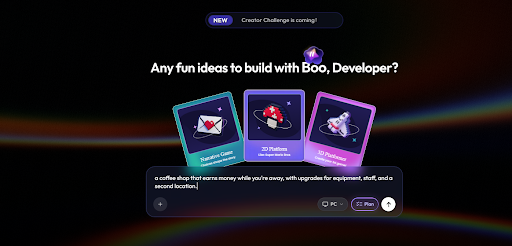
Step 1 — Describe the Theme: Open combos.fun and describe your idle theme to Boo in a single detailed sentence — “a coffee shop that earns money while you’re away, with upgrades for equipment, staff, and a second location.” The richer the theme, the more coherent the progression hierarchy Boo will generate.
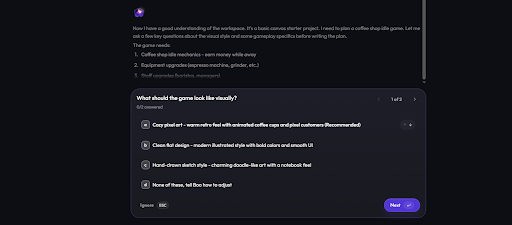
Step 2 — Confirm the Economy: Confirm the passive income mechanics, upgrade tree structure, and offline reward parameters in the Game Design Document. This is the most critical design stage for an idle game — the economic architecture underpins everything that follows.
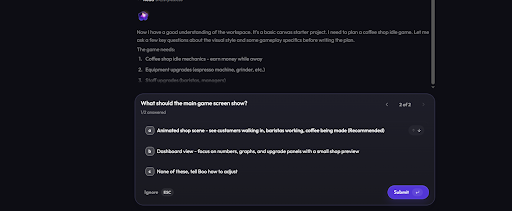
Step 3 — Generate the Systems: Let Combos generate the idle economy logic, UI counters, progress indicators, and visual assets. The core loop is functional and testable from this point — not a prototype you have to imagine, but one you can actually interact with.
Step 4 — Test Offline Progress: Test the offline progression by closing the browser, waiting five or ten minutes, then returning. Check whether the reward feels satisfying but not so large that it trivialises active play. This specific test is the most important one you will run on an idle game.
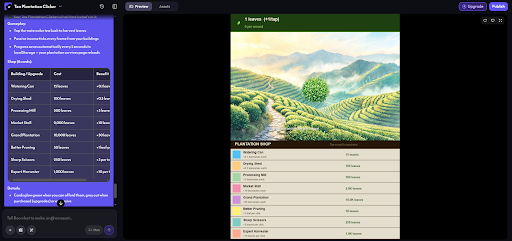
Step 5 — Publish and Share Screens: Publish and share with your audience — idle games spread most effectively through social sharing of progress screens and milestone moments. The shareable link from Combos makes this frictionless for players.
Calibrating the Return Reward: The Make-or-Break Moment
The moment a player returns to an idle game after being away is the highest-stakes moment in the entire game experience. Everything depends on whether that moment feels worth the wait. Return too little and the player has no reason to open the game at all. Return too much and active play feels pointless by comparison — if the same progress happens whether the player is engaged or not, why engage?
The ideal calibration creates a clear gradient: active play during a session should produce noticeably more progress than passive accumulation over the same period.
And the offline reward? It is the hook that brings the player back to the game; active play is the reason they stay for a session rather than collecting and closing. Both sides of this equation need to feel rewarding in their own right.
Upgrade Trees That Keep Choices Feeling Meaningful
The upgrade tree in an idle game is where design choices have the most visible impact on long-term engagement. A well-designed upgrade tree always presents the player with at least two meaningful options — not a choice between something useful and something useless, but a choice between two different approaches to progression that genuinely suit different player preferences.
A good upgrade tree accommodates both approaches and produces noticeably different progression rates without either path feeling like the obvious correct choice. Designing this balance in the GDD stage, before building, is far more efficient than trying to retrofit it afterward.
Themes That Give the Numbers Meaning
The best idle game themes have a natural scale hierarchy built into the concept — a clear narrative of growth from small to large that mirrors the mechanical progression and gives the accumulating numbers a sense of meaning beyond their quantity. A coffee shop grows into a chain, then a brand, then a global institution. Each threshold in the upgrade tree corresponds to a recognisable stage in that narrative.
When the player buys an upgrade that unlocks a second shop location, the increase in number is satisfying on a mechanical level. But the sense that they now run two shops — that the world of the game has changed — is what makes the moment memorable and shareable. That narrative layer is the difference between an idle game people describe to their friends and one they quietly close after a week.
Conclusion
Idle games are a serious design exercise dressed in a casual format. The economic architecture, the offline progression calibration, and the upgrade tree balance are all genuinely difficult to get right — and they require real playtesting with real players rather than internal analysis to validate. An AI game maker like Combos compresses the technical setup that would otherwise take days into minutes, giving you more time for the design work that actually determines whether the game is worth playing. Build it fast, test the offline loop honestly, and tune it until every return visit feels worth making.