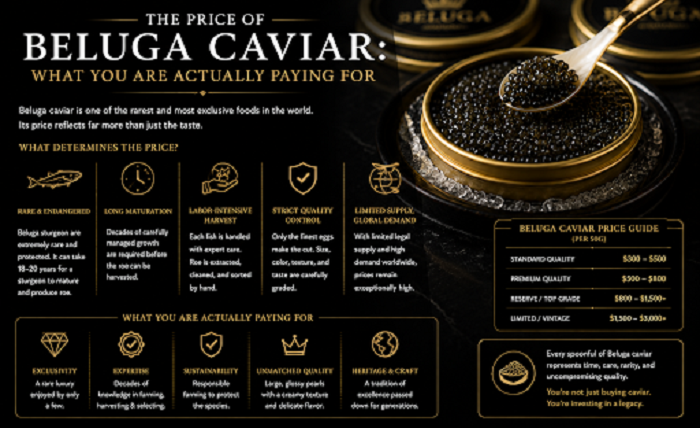
People see the price tag on beluga caviar and assume someone somewhere is having a good laugh at their expense. The caviar shop Bester Caviar lists its Royal Beluga Hybrid starting at $169 for 30 grams, which works out to roughly $5 per gram, and the immediate instinct for most people is that this has to be at least half marketing. It isn’t. The beluga caviar price reflects a production process that is genuinely unlike almost any other food category, and once you understand the numbers, the sticker shock gets a lot more rational.
This is not a defense of expensive food for its own sake. It is a breakdown of what actually happens between the fish and the tin, and why each step costs what it costs.
Most People Assume It Is Markup. It Is Not.
The markup on a bottle of wine at a restaurant can easily be 300 percent. A designer handbag often costs a fraction of its retail price to manufacture. So the assumption that luxury goods are mostly margin is not unreasonable, it just doesn’t apply here the way people expect.
The beluga hybrid caviar cost structure is driven by biology, not branding. You cannot rush a sturgeon. You cannot cut corners on the water system or the feed without it showing up in the roe. And you cannot fake the years of patient farming that go into a tin worth buying. The margins on quality caviar are actually quite thin compared to other luxury categories precisely because the input costs are so high and so fixed.
A lot of the price for beluga caviar is spent before a single egg is harvested. That’s the part most people don’t think about, because most foods don’t work that way.
The 15-Year Problem: Why Raising Beluga Takes So Long
This is the number that tends to stop people. A female Beluga hybrid sturgeon takes somewhere between 12 and 18 years to reach sexual maturity and produce roe for the first time. At Giaveri Farm in northern Italy, one of the farms Bester sources from, they say it takes over 15 years to obtain their beluga caviar. That is not a figure they put in the marketing copy to sound impressive. It is a biological reality of the species.
Think about what that means from a business standpoint. You build a farm, you invest in infrastructure, you stock it with juvenile fish, and then you wait fifteen years before you have a product to sell from those fish. During those fifteen years you are paying for water, feed, staff, electricity, insurance, and loan interest on the capital you put in at the start. The fish eat for fifteen years before they produce anything.
This is why the price for beluga caviar has a floor that doesn’t exist for most foods. Even if you stripped out every margin in the supply chain, the biological timeline alone makes this an expensive product to produce. There is no version of this that costs the same as farmed salmon.
What a Serious Caviar Farm Actually Costs to Run
A proper sturgeon aquaculture operation is closer to an industrial facility than a fish pond. Sturgeons need cold, clean, well-oxygenated water maintained at specific temperatures year-round. In most farming locations that means recirculating aquaculture systems, which filter and treat water continuously rather than relying on natural waterways. These systems are expensive to build and expensive to run.
Feed is another significant line item. Sturgeon are carnivorous and need protein-rich feed, usually based on fish meal and fish oil, to develop the fatty acid profile that makes their roe worth eating. The omega-3 content in the roe is directly tied to the quality of what the fish eat. Cheap feed produces cheaper tasting caviar. Farms that want to produce something at the level of Giaveri or Karat don’t cut that corner.
Then there is staffing. Monitoring fish health over a 15 year production cycle requires trained aquaculture specialists. Harvesting roe is a skilled manual process. Processing and grading the eggs requires experience that takes years to develop. This is not a commodity production line.
From Fish to Tin: Processing, Packaging, and the Cold Chain
Once the roe is harvested, the clock starts ticking. Fresh non-pasteurized caviar is highly perishable, and every step between the fish and the customer has to happen fast and cold. The roe is rinsed, graded by size and color, salted using the traditional malossol method (which uses the minimum salt needed to cure the eggs without masking their flavor), then packed into tins and moved immediately into cold storage.
Shipping is not cheap. Bester sends every order via UPS Next Day Air in a Styrofoam cooler with frozen gel packs calibrated to hold temperature for a full day of transit. That packaging alone costs money on every single order. There is no slow shipping option because there is no version of fresh non-pasteurized caviar that survives slow shipping in acceptable condition.
The cold chain from farm to customer is not a minor logistical detail. It is a significant ongoing cost that gets baked into the price of every tin.
How Import and Retail Margins Stack On Top
If you buy beluga hybrid caviar from a specialty food retailer, you are paying the farm cost, the processing cost, the shipping cost to the importer, the importer’s margin, the shipping cost to the retailer, and the retailer’s margin. Each layer is reasonable on its own. Together they can double or triple the price by the time the tin reaches you.
Direct import, which is how Bester operates, cuts out most of those layers. The company buys directly from its partner farms, which removes the intermediary importer markup. That’s why the same quality product often costs significantly less from a direct importer than from a multi-tier retail supply chain.
Even so, the underlying product cost is high enough that there is no dramatic bargain version of genuine beluga hybrid caviar. Anyone selling it at a price that seems too good to be true is either selling a different species mislabeled, a pasteurized product with a much longer shelf life, or something that didn’t go through the kind of farming and processing described above.
So Is the Price Actually Justified?
How much is beluga caviar? At the direct importer level, expect to pay around $160 to $200 for 30 grams of genuine beluga hybrid from a farm like Giaveri. At a retail store or restaurant, the same quantity can run $250 to $400 or more.
Why is beluga caviar so expensive? The short answer: 15 years of farming, expensive water systems and feed, skilled manual processing, and a cold chain that cannot be cheapened without ruining the product.
Whether that is worth it is a personal question and an honest one. There are people for whom $180 for a small tin of caviar makes no sense at any level of quality. That’s a completely fair position. But if you are trying to decide whether the price reflects real costs or just a luxury tax on a status symbol, the answer is that it mostly reflects real costs. The margins in serious caviar production are not what people assume. The biology is the expensive part, and nobody has figured out how to make a sturgeon grow up faster.