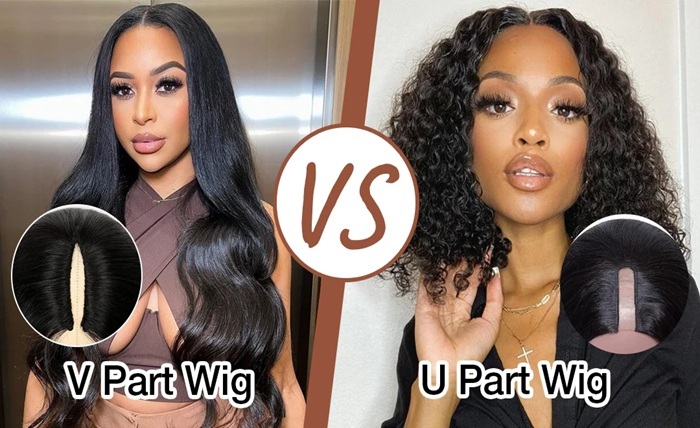
If you’re shopping for a wig that looks like your real hair—without glue, lace cutting, or hours of installation—both V part wigs and U part wigs are top contenders. They’re often described as “beginner-friendly” and “natural-looking,” but they’re not identical, and the one that looks more realistic depends on how you wear your hair, how much leave-out you’re comfortable with, and what “natural” means for your day-to-day life.
This guide compares V part wigs vs U part wigs with a clear focus on realism: how believable the part looks, how well each blends, what they look like up close, and which option makes the most sense for different hair types and styling habits.
Quick definitions: what’s the actual difference?
U part wig:
Has a U-shaped opening at the top. You leave out a section of your natural hair around the opening to cover the wig’s edges and create a natural part and hairline. The opening is typically wider, which can make blending easier—but requires more leave-out.
V part wig:
Has a narrower V-shaped opening. The idea is to reduce the amount of leave-out needed while still letting your real scalp show at the part. Because the opening is smaller and more focused, the part can look sharper and more “scalp-like” when blended well.
1) Which one looks more natural at the part line?
If your priority is a realistic part, V part wigs often have a slight advantage.
- V part realism: The V opening creates a more concentrated, “precision” part area. Since a smaller section of your own hair is exposed, the part can look cleaner—especially for center parts or subtle off-center parts. In normal lighting, it’s easy for it to read as your natural scalp.
- U part realism: A U part wig can look just as natural, but the opening is wider and the part area is more flexible. That flexibility can be a plus, yet if you don’t place it carefully or if the leave-out doesn’t fully cover the seam, the transition can sometimes be more noticeable.
Verdict (part only):
V part wigs tend to look more natural at the part for many beginners, because the design “forces” a clean part and requires less exposed hair to get the scalp effect.
2) Which one blends more seamlessly?
Blending depends on two things: leave-out match (texture, density, color) and how much leave-out you have.
- U part blending: Because you have more leave-out, you also have more real hair available to camouflage the wig’s edges. For people with thicker natural hair or those comfortable heat-styling, U part wigs can blend exceptionally well—especially around the crown and top.
- V part blending: Less leave-out means less work and less heat exposure, but it also means your blending has to be more accurate. If your leave-out is too short, too thin, or a different texture, the contrast can show quickly because there’s less real hair to “cover mistakes.”
Verdict (blending):
U part wigs can blend easier for people with enough hair density and styling patience. V part wigs can still blend beautifully, but they’re less forgiving when your leave-out doesn’t match.
3) Which looks more natural up close (and in harsh lighting)?
Harsh lighting, phone flash, and close-up angles reveal the details: seam visibility, density differences, and whether the top looks “wiggy.”
- V part in close-up: If installed correctly, the seam area is usually smaller, so there’s less to hide. That can help in close-ups. However, if the top density of the wig is much thicker than your leave-out, the contrast at the opening can stand out.
- U part in close-up: With more leave-out, you can disguise the seam better—if you lay the leave-out properly. But if the opening is too wide for your natural hair’s density, you may struggle to cover the edges fully, and the seam can become visible in bright light.
Verdict (close-up):
It depends on your natural hair density. With thinner hair or minimal leave-out, V part can look more convincing. With thicker hair and enough leave-out to cover well, U part can be equally flawless.
4) Which one is better for hair health (and still looks natural)?
Natural-looking shouldn’t come at the cost of damaged leave-out.
- V part advantage: Less leave-out usually means less heat styling and less manipulation overall. That’s a big deal if you’re aiming to protect your hair while still enjoying a realistic finish. Many people choose a v part human hair wig specifically because human hair blends more naturally and lets you use minimal heat while still achieving a believable look.
- U part tradeoff: More leave-out can mean more frequent straightening, curling, or product use to match the wig texture—especially if the wig is very different from your natural pattern. If you’re not careful, the leave-out becomes the most vulnerable part of your routine.
Verdict (hair health + realism):
V part often wins for those who want a natural look with less leave-out stress, provided the texture match is good.
5) Which is more versatile for styling?
If “natural” to you means changing parts, doing half-up styles, or pulling hair back, versatility matters.
- U part versatility: Generally offers more freedom to shift the part slightly or create different top looks because the opening is wider. You can sometimes achieve a more “installed” effect for certain styles.
- V part versatility: Usually more limited in parting because the V opening is specific. You can still style it, but it’s best for people who like a consistent part and simple daily looks.
Verdict (styling versatility):
U part wigs are typically more versatile. If you like changing your part often, U part may look more natural for your lifestyle because it matches how you normally style your hair.
6) What about curly textures—V part vs U part?
Curly units can look incredibly realistic because curls hide transitions—but they also require more maintenance and texture matching.
- Curly V part: A v part curly wig can look very “grown-from-the-scalp” if your leave-out curl pattern is similar. The smaller opening helps, but the leave-out must be defined to avoid a frizzy mismatch at the top.
- Curly U part: The extra leave-out can make blending easier if your natural curls are dense and similar in size. But if your hair is finer, having to define and maintain a larger leave-out area can be time-consuming and more prone to dryness.
Verdict (curly):
If your natural curl pattern matches well and you want minimal leave-out, V part can look more natural with less effort. If you have dense curls and don’t mind more leave-out, U part can blend like a dream.
So, which one looks more natural overall?
Choose a V part wig if you:
- Want the most realistic part with minimal leave-out
- Prefer quicker installs and less daily blending
- Want to reduce heat and manipulation on your natural hair
- Like a consistent part (center/off-center) and simple styling
Choose a U part wig if you:
- Have enough natural hair density to cover a wider opening
- Want more flexibility in parting and top styling
- Don’t mind doing more blending work to get a seamless finish
- Regularly heat-style or can easily match your natural texture
Bottom line
For many people—especially beginners—V part wigs often look more natural at the part, while U part wigs can look equally natural overall when you have the hair density and styling routine to blend a wider opening. The “most natural” option is the one that fits your real hair, your time, and the level of leave-out you’re comfortable maintaining consistently.