
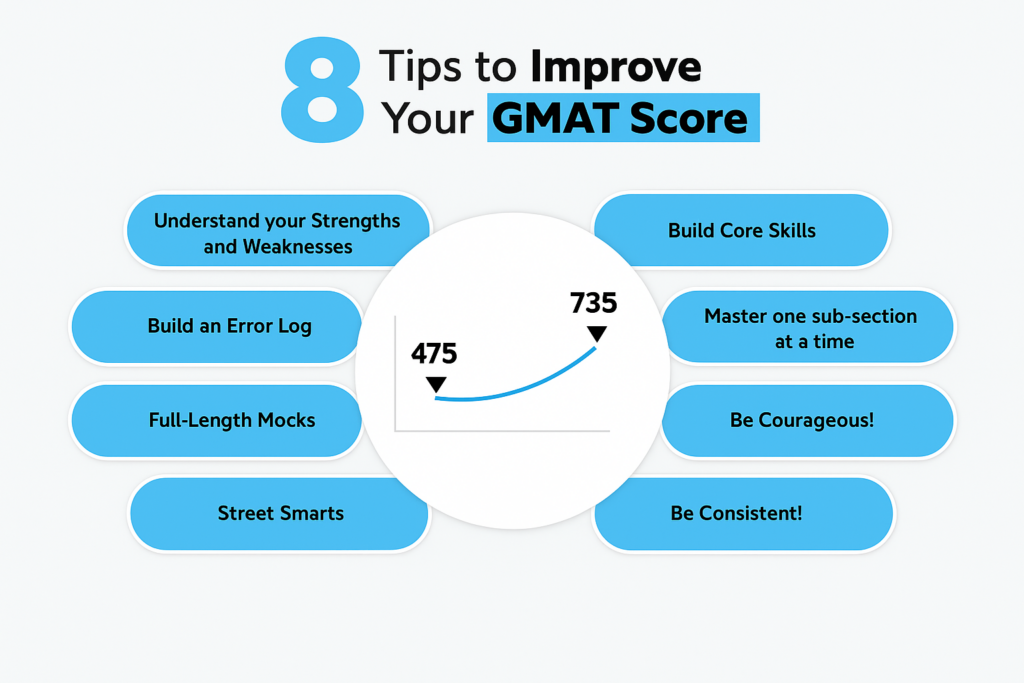
The GMAT is a gateway that opens doors for pursuing studies at top B-schools. Your GMAT score determines the admission possibilities of entering the top global business schools or strengthening your application for an Indian MBA program. Many students start with an “average” score on mock tests, usually between 450 and 600. But here is the good news: your starting point does not define your destination.
Improvement is very much possible. If approached correctly, with enough discipline, and using the best GMAT classes Mumbai that students rely on, even a modest baseline can grow into something truly remarkable.
In this guide, we break down exactly how to transform your GMAT performance: step by step.
1. Start With a Reality Check: Know Your Baseline
Undoubtedly, an accurate evaluation is a prerequisite to success on the GMAT. You should complete a fully timed diagnostic test as if you were actually taking the exam. Do not be concerned with the score; you are only assessing where you begin, not what your current level of intellect is.
This baseline helps you to understand:
- Your strengths: Quant, Verbal and Data Insights
- Your weaknesses: timing, fundamentals, and strategy
- Your conceptual gaps
- Your stamina and test-taking habits
When you know where you stand, then you can build the strategy to get where you want to go.
2. Understand What the GMAT Really Tests
Many students mistakenly think that the GMAT is a math-and-English test. It is not.
The GMAT tests:
- Logic
- Pattern recognition
- Data sufficiency reasoning
- Critical thinking
- Time management
Understanding this shift in mindset is the first big leap from “average” to “outstanding.”
For instance:
- You should view quant as a way of completing multiple choice questions quickly, and that it is possible to do this without knowledge of difficult mathematics.
- The verbal section is not solely about vocabulary; you must be familiar with the Various Logical and Grammatical Rules and be able to evaluate the Structure of Arguments. All of these Areas Are Significantly Related to Improving Your GMAT Score.
If you master the underlying logic, your score can improve rapidly.
3. Build Strong Fundamentals Before Pushing for 705+
One of the biggest mistakes that most test-takers commit is starting to practice questions without fortifying their foundations.
Before proceeding to advanced concepts:
- Review algebra, arithmetic and number properties
- Understand GMAT grammar rules: modifier placement, pronouns, and parallelism.
- Learn to understand the rules of logic and do not try to memorize them.
- Master critical reasoning question types.
This is the foundation stage that transforms random practice into effective practice.
4. Learn GMAT-Specific Techniques and Shortcuts
Common GMAT strategies include:
- Plugging in values for Data Sufficiency
- Back-solving with answer choices
- Eliminating non-viable answers quickly in Verbal
- Spotting patterns in number properties
- Using logical shortcuts for Critical Reasoning
5. Make Practice a Habit, Not a One-Time Sprint
Your GMAT transformation depends heavily on consistency.
At least study 2 hours a day for 30 days, which makes you consistent and results in a boost in marks.
A strong practice routine ensures:
- Better retention
- Improved confidence
- Long-term understanding
- Mental stamina for the 3-hour exam
Try following this weekly structure:
- 2–3 Quant sessions
- 2–3 Verbal sessions
- 1 full-length mock test
- 1 review day
6. Analyze Every Mistake Like a Scientist
Taking a mock test is only half the battle. The real improvement happens during review.
For every question you get wrong (or took too long on), ask yourself:
- Did I understand the concept?
- Did I misread the question?
- Did I fall for a trap?
- Did I run out of time?
- Did I choose the right method?
Top scorers improve not because they’re perfect, but because they understand every mistake so it never happens again.
7. Train Your Timing: The Silent Score Killer
Even brilliant students get stuck at 580–650 because they mismanage time.
Common timing problems:
- Spending too long on the first 5–7 questions
- Obsessing over tough Quant questions
- Not using guess strategies
- Rushing the last 10 questions
Practicing with a stopwatch helps. So does using:
- “1.8 minutes per Quant question”
- “1.6 minutes per Verbal question”
8. Take Full-Length Adaptive Mocks
Your GMAT score transformation depends heavily on mock tests.
Mock tests help you:
- Learn pacing
- Build stamina
- Adapt to question difficulty
If you start with a 550 mock score, consistent training can push it to:
- 605 in 2–3 weeks
- 655 in 1–2 months
- 705+ with sustained discipline and right guidance
Mocks are the bridge between your preparation and your dream score.
9. Surround Yourself With Quality Coaching and Material
When choosing the best GMAT classes Mumbai, students’ trust can be a game-changer. Good coaching offers:
- Structured study plans
- Expert faculty
- Doubt-solving support
- Strategy training
- Adaptive practice
10. Trust the Process — GMAT Improvement Is Real
Thousands of students start at “average” scores and rise to 705+. What separates them?
Not intelligence.
But:
- consistency
- strategy
- personalized coaching
- disciplined practice
If you follow the roadmap above, your GMAT score transformation is absolutely within reach.
Your Journey Starts Now
If you are aiming for a higher score and want structured expert-led guidance; choosing the right coaching matters. Many students in the city keep rating Jamboree India as the best GMAT classes provider in Mumbai, relying only on getting strong results of 705+. With years of experience, a focus study plan and a test-specific strategy, it has built a reputation as one of the top GMAT classes in Mumbai and is often recognized as the best GMAT institute option for serious aspirants.
Get the best guidance from the experienced tutors today.