Projects rarely fail because teams lack technical expertise. Most failures happen because organizations struggle to adapt their delivery models to changing business realities. A framework that works for a software rollout may fail completely in a regulatory compliance initiative or infrastructure modernization effort. Yet many project professionals still rely too heavily on a single methodology.
This operational mismatch has become a growing challenge for enterprise leaders across the United States. Companies are managing distributed teams, evolving compliance demands, AI-driven workflows, and shifting stakeholder expectations all at once. As a result, organizations increasingly expect project managers to move comfortably between Agile, predictive, and hybrid delivery environments.
For professionals trying to stay competitive in this climate, a structured project management course has become less about certification alone and more about developing practical decision-making skills that align execution with business priorities.
Why Traditional Delivery Models Are No Longer Enough
For years, organizations treated Agile and Waterfall as opposing systems. Teams were often pressured to choose one methodology and apply it universally across every department and initiative. That approach created rigid execution models that struggled under real-world complexity.
Modern organizations operate differently.
A healthcare provider may require predictive governance for compliance reporting while simultaneously using Agile sprint cycles for patient-facing applications. Financial institutions often balance long-term infrastructure programs with rapid digital product development. Manufacturing firms now combine traditional operational planning with iterative innovation cycles.
The result is a workplace where project managers must understand:
- When structured governance is necessary
- Where iterative development improves delivery
- How stakeholder expectations differ across departments
- Which methodology supports business risk reduction
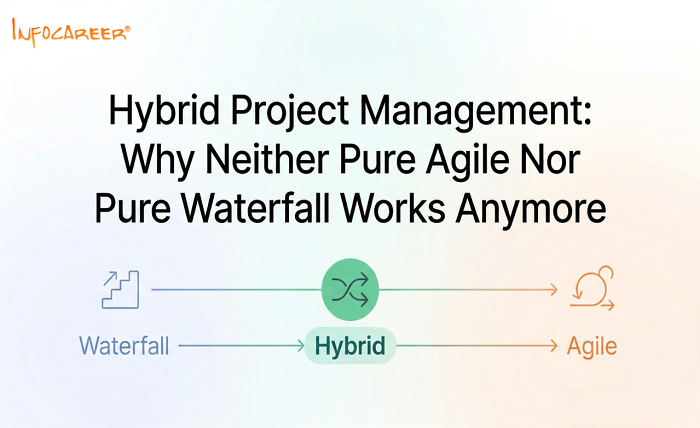
Hybrid project management has emerged as the operational response to these realities.
The Shift Toward Business-Centered Project Leadership
Project management responsibilities have expanded beyond schedules, budgets, and task tracking. Leadership teams now expect project managers to contribute directly to organizational outcomes.
That expectation changes the skills required for advancement.
Today’s project leaders are expected to:
Align Delivery With Strategic Objectives
Executives increasingly evaluate projects based on measurable business impact rather than completion alone. Project managers must understand how delivery decisions affect revenue, compliance, operational continuity, and long-term organizational priorities.
Navigate Cross-Functional Complexity
Large organizations rarely operate in isolated workflows. Project leaders must coordinate across finance, operations, engineering, legal, and executive leadership while managing competing priorities and communication challenges.
Make Situational Decisions
Rigid methodology adherence often creates inefficiencies. Hybrid environments demand professionals who can evaluate context, assess risk, and tailor frameworks based on project conditions rather than ideology.
These expectations are reshaping hiring and promotion standards across industries.
Why Employers Are Prioritizing Hybrid Methodology Experience
Organizations are increasingly cautious about leaders who specialize in only one delivery approach. Employers want professionals who can adapt execution strategies without compromising governance or delivery speed.
Several factors are driving this change.
Digital Transformation Initiatives Continue to Expand
Enterprise modernization projects involve overlapping systems, multiple vendors, regulatory requirements, and evolving customer expectations. These projects rarely fit into a single methodology structure.
Distributed Teams Require Flexible Coordination
Remote and global collaboration has introduced new communication and workflow challenges. Hybrid management practices help organizations balance documentation, accountability, and rapid iteration across geographically dispersed teams.
AI and Automation Are Changing Planning Models
Organizations are beginning to integrate AI-driven forecasting, risk analysis, and workflow optimization into project operations. Project managers must understand how to incorporate these tools while maintaining governance standards and human oversight.
This evolution has made adaptability one of the most valuable professional traits in project leadership.
The Growing Importance of Governance and Business Environment Skills
One of the biggest shifts in modern project management is the increasing focus on governance and organizational strategy.
Technical delivery knowledge still matters, but companies are placing more value on professionals who understand:
- Risk management frameworks
- Regulatory compliance
- Stakeholder governance
- Organizational change management
- ESG-related project considerations
- Portfolio-level business alignment
These competencies have become particularly important in industries where operational disruption carries financial or reputational consequences.
Professionals who understand both execution and governance are often positioned for higher-authority leadership roles because they reduce uncertainty for executive teams.
Why Structured PMP Preparation Still Matters
Many experienced professionals already manage projects successfully in their day-to-day roles. The challenge is that practical experience alone does not always provide standardized decision-making frameworks or enterprise-level governance knowledge.
Structured PMP preparation helps professionals formalize their expertise in areas such as:
- Hybrid methodology application
- Strategic stakeholder management
- Business environment analysis
- Risk-based decision-making
- Cross-functional leadership
- Enterprise governance standards
This becomes particularly relevant as organizations continue standardizing leadership expectations across global teams.
The upcoming PMP exam updates scheduled for 2026 also reflect this broader industry shift toward adaptive leadership and business integration rather than narrow technical execution.
Professionals who invest in these capabilities now are positioning themselves for a market that increasingly rewards operational flexibility over methodology loyalty.
As project environments continue to evolve, the distinction between technical coordinator and strategic project leader will become even more significant. Additional insights into professional training pathways and evolving project leadership standards can be found at Sprintzeal.