Anxiety is one of the most common mental health conditions in the United States, yet a surprising number of people who live with it never receive any formal treatment. Some manage for years with coping strategies that work well enough. Others find that their symptoms gradually intensify until everyday tasks feel impossible. Understanding the full range of treatment options available, and knowing what each level of care actually involves, can make a meaningful difference in how someone approaches getting help.
This article walks through how anxiety disorders are diagnosed, the spectrum of treatment settings from self-directed tools to highly structured clinical programs, the types of therapy that research consistently supports, and the factors that help determine which level of care fits a given person’s situation. Whether you are exploring options for yourself or trying to understand what a loved one is going through, this overview is meant to give you a clearer, more grounded picture.
What Makes Anxiety a Clinical Condition
Everyone feels anxious sometimes. A presentation at work, a medical appointment, a difficult conversation with a family member, these situations naturally produce some degree of worry or tension. Clinical anxiety is different in a specific and important way: the response is disproportionate to the actual threat, it persists well beyond the triggering event, and it begins to interfere with normal functioning.
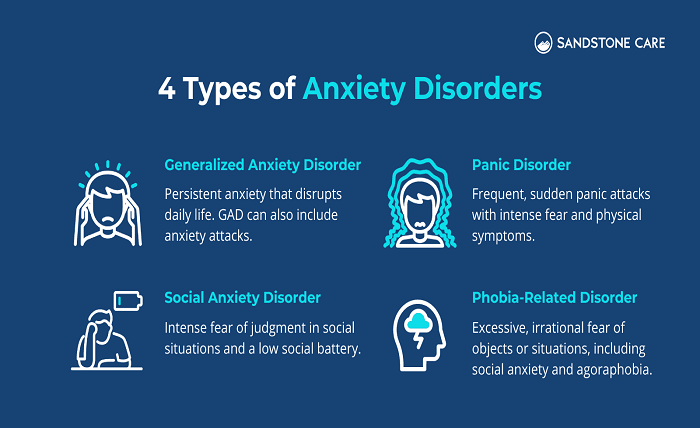
The Diagnostic and Statistical Manual of Mental Disorders (DSM-5) categorizes several distinct anxiety disorders, each with its own defining features. Generalized Anxiety Disorder involves chronic, hard-to-control worry about a wide range of topics. Panic Disorder centers on recurrent panic attacks and the persistent fear of having another one. Social Anxiety Disorder involves intense fear of social situations where judgment or embarrassment might occur. Specific phobias, separation anxiety disorder, and agoraphobia each carry their own diagnostic criteria. What these conditions share is that they cause real distress and real impairment, not just ordinary stress.
According to the National Institute of Mental Health, anxiety disorders affect roughly 19 percent of adults in the United States each year, making them the most prevalent category of mental health disorder. Despite this, only about 43 percent of those affected receive treatment. The gap between prevalence and treatment is partly explained by stigma, partly by cost and access barriers, and partly by the fact that many people are simply uncertain about where to start.
The Spectrum of Treatment Settings
Treatment for anxiety does not follow a single path. There is a genuine continuum of care, and where someone enters that continuum depends on factors like symptom severity, how long the condition has been present, whether other mental health issues are co-occurring, and the degree to which daily life has been disrupted.
| Level of Care | Setting | Best Suited For | Weekly Time Commitment |
| Self-directed / Digital tools | Home | Mild symptoms, early-stage concerns | Flexible |
| Outpatient therapy | Clinic or telehealth | Mild to moderate symptoms, stable daily life | 1 to 2 hours |
| Intensive Outpatient Program (IOP) | Clinic, partial remote | Moderate symptoms, some functional impairment | 9 to 15 hours |
| Partial Hospitalization Program (PHP) | Clinic or hospital-based | Moderate to severe, needs more support than IOP | 20 to 30 hours |
| Inpatient / Residential | Facility | Severe symptoms, safety concerns, or failed outpatient care | Full-time, 24-hour support |
Most people begin at the outpatient level. A therapist, psychologist, or psychiatrist sees them once or twice a week, and treatment proceeds from there. This works well for a large portion of people with anxiety, particularly when symptoms are caught relatively early and the person has stable support in their day-to-day life.
When outpatient care is not sufficient, stepping up to an Intensive Outpatient Program provides more structured support without requiring someone to leave their home environment overnight. A Partial Hospitalization Program offers an even higher dose of daily treatment, often running five days a week for several hours each day, while still allowing the person to sleep at home. For those whose symptoms are severe enough to pose a safety risk, or who have not responded to less intensive options, inpatient anxiety treatment provides round-the-clock clinical support within a residential or hospital-based setting, allowing for more intensive monitoring, medication management, and therapy.
Therapies with Strong Research Support
Across all levels of care, certain therapeutic approaches appear consistently in the evidence base for anxiety treatment. Cognitive Behavioral Therapy, or CBT, is probably the most well-established. It focuses on identifying the thought patterns that fuel anxiety and gradually changing both the thoughts and the avoidance behaviors that maintain the condition over time.
Exposure therapy is a specific component of CBT, or sometimes delivered on its own, that involves systematically and safely confronting feared situations or thoughts rather than avoiding them. This can feel counterintuitive at first, but a large body of research supports it as one of the most effective tools for reducing anxiety over the long term.
Acceptance and Commitment Therapy, known as ACT, takes a different angle. Rather than challenging the content of anxious thoughts, ACT encourages people to accept those thoughts without letting them dictate behavior, while committing to actions that align with personal values. It has shown solid results particularly for generalized anxiety and is increasingly used alongside CBT approaches.
Medication is also a legitimate and often effective part of treatment, especially for moderate to severe anxiety. Selective serotonin reuptake inhibitors (SSRIs) and serotonin-norepinephrine reuptake inhibitors (SNRIs) are typically the first-line pharmacological options. Buspirone is another option for generalized anxiety. Benzodiazepines, while effective for short-term relief, carry dependency risks and are generally used cautiously and for brief periods.
Factors That Influence Treatment Recommendations
Choosing the right treatment approach is rarely straightforward, because anxiety rarely shows up in isolation. A clinician evaluating someone with an anxiety disorder will consider several overlapping factors before making a recommendation.
- Severity and duration of symptoms: How intense are they, and how long have they been present?
- Functional impairment: Is the person able to work, maintain relationships, or take care of basic responsibilities?
- Co-occurring conditions: Depression, PTSD, substance use disorders, and ADHD frequently appear alongside anxiety and can significantly shape treatment planning.
- Previous treatment history: Has the person tried therapy or medication before? What worked, and what did not?
- Safety concerns: Are there thoughts of self-harm, or has the anxiety reached a point where the person is unable to care for themselves?
- Support system: Does the person have family or social support available outside of treatment settings?
- Practical considerations: Insurance coverage, transportation, work schedules, and geographic access all affect which options are realistic.
A thorough intake assessment with a mental health professional is typically the starting point for sorting through these factors. This process usually involves a clinical interview, sometimes supplemented by standardized questionnaires like the GAD-7 for generalized anxiety or the PDSS for panic disorder. The goal is to build a clear picture of what is actually going on before making any recommendations.
What Progress in Anxiety Treatment Actually Looks Like
One of the things that surprises people entering treatment for the first time is that progress is rarely linear. Weeks where someone feels genuinely better are sometimes followed by weeks that feel harder. This is normal, and it does not mean treatment is failing. It usually reflects the natural variability of anxiety as a condition, combined with the reality that therapeutic work, especially exposure-based work, can temporarily increase distress before it reduces it.
Most research on CBT for anxiety disorders shows meaningful improvement within 12 to 20 sessions for outpatient treatment. However, “meaningful improvement” does not always mean complete remission. Many people experience a substantial reduction in symptoms and a significant recovery in functioning without their anxiety disappearing entirely. The realistic goal for most people is not the absence of anxiety but a reduction in how much it controls their choices and limits their life.
Maintenance matters too. People who continue practicing the skills they learned in therapy, whether that involves continuing low-dose medication, periodic check-ins with a therapist, or consistent use of behavioral strategies on their own, tend to maintain their gains better than those who stop all intervention immediately after feeling better. Anxiety has a tendency to return under stress, and having a plan for those moments is part of good long-term care.
Taking the First Step Toward Treatment
Reaching out for help with anxiety can itself be anxiety-provoking, which is not lost on anyone who works in this field. The uncertainty about what treatment will involve, the fear of judgment, the concern about cost, all of these are common barriers. But the evidence is consistent: untreated anxiety tends to worsen over time, while treated anxiety responds well in the majority of cases.
Starting with a conversation with a primary care physician is a reasonable entry point for many people. A referral to a mental health professional, a brief screening, or a prescription for medication can all come from that initial visit. Community mental health centers often offer sliding-scale fees for those without insurance or with limited coverage. Telehealth has also expanded access significantly, making it possible for people in rural areas or with demanding schedules to connect with qualified therapists more easily than before.
The shape of effective anxiety treatment looks different for different people. Some find that a few months of outpatient therapy gives them the tools they need. Others require a longer course of treatment, a combination of therapy and medication, or a structured program to make real headway. What matters most is finding a level of care that matches the actual severity of the condition, working with clinicians who use evidence-based approaches, and staying engaged with the process long enough for those approaches to take hold.