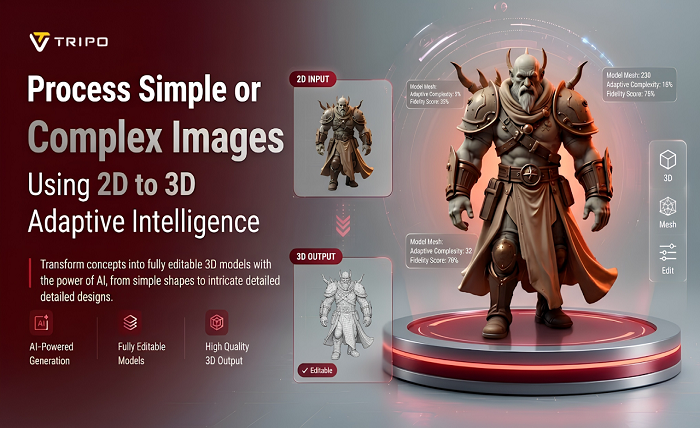
Intelligent reconstruction technologies have made great progress in image-to-model conversion. Initial systems were very demanding in terms of manual fine-tuning and technical know-how. New platforms offer improved and more rapid visual information analysis. One of the main problems in image reconstruction workflows is the complexity of the images. Simple objects do not pose as many problems of interpretation as dense scenes. Tripo 3D’s solution to the differences is adaptive intelligence systems. These systems assess the visual structures prior to the reconstruction. Adaptive analysis is applied for the synthesis of consistent geometry from different inputs. As a result, Tripo 3D provides scalable conversion workflows for many types of images.
Understanding Adaptive Intelligence in 2D to 3D Workflows
Adaptive intelligence dynamically adjusts reconstruction methods according to the input. Tripo 3D does not use the same processing rules for all the images; rather, it processes each one separately. It explores shapes, depth marks, contours, and surface data on the platform. This analysis helps to make reconstruction decisions throughout the workflow. Complex images and simple references are processed differently. The system can comprehend illustrations, concept art, product images, and sketches. This flexibility helps to increase consistency with different visual inputs. Tripo 3D creates structured geometry using 2d to 3d reconstruction, and retains key features of the source material’s visual qualities.
Processing Simple Images into Structured 3D Models
Simple pictures usually contain one main subject that is easy to see, and there are not too many distractions. These may include images of the product, geometric forms, transparent drawings, etc. Tripo 3D is able to identify symmetry, proportions, and main structural properties in a very short time. The platform is able to capture key geometric data from visible areas. Uncluttered scenes are still easier to interpret when it comes to shape boundaries. Organized mesh structures are created around detected geometry as reconstruction starts. This can lead to very coherent, usable, and editable assets. Depending on the project, Tripo 3D can also output geometry for subsequent refinement, texturing, animation, and auto rigging processes.
Handling Complex Images with Multiple Visual Elements
Complex images are images with overlapping objects, detailed surfaces, and challenging visual relationships. These types of scenes need to be analyzed more in-depth prior to geometry generation. Tripo 3D concentrates on the visible clues to recognize individual structures. The platform also predicts the occluded regions. Object relationships remain important in the reconstruction accuracy assessment. Ambiguity of depth and boundaries can be caused by dense visual information. Adaptive processing helps address these challenges by interpreting visual information within its context. A multi-view reference system enhances the understanding of the structure in challenging topics. These features support high-fidelity reconstruction workflows for usable 3D assets and prototype-ready models.
Adaptive Features Within Tripo 3D Conversion Workflows
Several adaptive systems contribute to reconstruction quality within Tripo 3D workflows:
- Depth Inference Systems: Interpret visual features for depth and structure.
- Surface Recognition: Identify visual surface qualities and inform texture choices.
- Shape Interpretation: Evaluate contours and boundaries of objects for enhancing object reconstruction.
- Topology Generation: Create structured meshes for easier subsequent editing.
- Multi-View Integration: Combine several references for a more complete geometry.
- Input Adaptability: Adapt reconstruction strategies according to the complexity level of images.
Working together, these systems can process both simple and highly detailed images within Tripo 3D. It can also be used for workflows with illustrations, concept sketches, photos, and even references from free 3d models to compare.
Steps to Process simple or complex images using 2D to 3D adaptive intelligence
Step 1: Add image inputs for AI analysis
- First, you need to access Tripo 3D and signup. Next, go to the “Model” tab present in the vertical left menu bar.
- Under the menu, click on the “HD Model”.
- You can drag and drop to upload the image, or you can also upload the image from a specific location of your device using the “Upload” tab.
Step 2: Fine-tune model settings for image complexity
- Under the “General settings” tab, you can either allow the AI to completely generate on its own by switching “AI complete”. Or you can turn on texture and select the custom “Texture Quality” like 2K, 4K, or 8K.
- You can also turn on “PBR” for accurate material reflective properties.
- For better topology characteristics, select either “Quad” or “Triangle” topology.
- You can also set the custom polycount.
- Later choose the model from the list, including v3.1 best quality, v3.0 fast and balanced, or v2.5 legacy.
- If you are a member, then you can choose “Generate in Parts”, “8K Texture”, and “Privacy” options.
- Finally, click on the “Generate Model” to begin generation.
Step 3: Inspect and export completed models
- Tripo 3D allows you to completely view your model in the style you want. Key styles include “Solid View”, “Cartoon Style”, “Sketch Style”, “Hologram Style”, and “Unlit” form. You can also “Refine” your design right through the bottom menu.
- You can also edit the “Environment Settings” and camera settings through “Reset Camera”.
- You can 3D print the design you want, or you can share it directly by clicking “3D Print”.
- In the end, click on the “Export” tab from the bottom menu. Next, choose the resolution, format, and filename, and click again on “Export” to save the design to your local device.
Factors That Influence Conversion Outcomes
There are a number of factors that influence the quality of reconstruction, irrespective of functions. Resolution of the images is one of the important factors in feature detection. Good photos will provide more data for analysis. The visibility of the subjects also has an impact on the consistency of their reconstruction. Coherent geometry is more likely to be generated by isolated objects. Another important factor is the reference quantity. Multiple views: decrease the uncertainty of hidden surfaces. As shape complexity increases, the amount of information that must be interpreted also grows. Detailed materials, intricate contours, and overlapping components are analyzed in-depth. Cleaner reference images in Tripo 3D help reduce visual ambiguity. Knowing these factors can help to produce more usable 3D content from uploaded imagery.
Enhancing Reconstruction Quality Through Configuration Settings
The results of reconstruction can be vastly different depending on the configuration options. Texture quality settings define the amount of detail that is created on the surfaces generated. The higher the texture resolution, the more detailed the texture will look. Geometric density and editing flexibility are both impacted by polycount customization. Smaller numbers can make workflows with light assets easier. The higher the value, the more surface detail that will be preserved. Downstream modification processes are also dependent on the choice of topology. The quad topology can be a suitable option for high-level editing requirements. Triangle topology is still appropriate for many visualization applications. PBR material options enhance material representation with physically based rendering concepts. Proper setting choices can help align the generated assets with specific project requirements.
Managing Editable Assets After Conversion
After assets are rebuilt, they are often thoroughly evaluated and enhanced. Always verify geometry for any inconsistencies or unwanted artifacts first. Discuss edge flow, surface continuity, and mesh organization. Tripo 3D has visualization modes that make this review process easier. Additional enhancements can be made to improve the structural clarity before export. The texture can be adjusted to enhance the appearance in the applications. The intended usage requirements should also be taken into account when preparing assets. For various workflows, there are various formats and optimization methods. There are many design environments, game engines, visualization platforms, and print workflows supported for export. These changes facilitate the effective and agile creative pipelines.
Conclusion
Adaptive intelligence is a key factor in modern image reconstruction workflows. Geometric interpretation processes are streamlined in simple images. For complex scenes, more analysis and context are needed. Tripo 3D has solutions for both scenarios: flexible reconstruction systems. Features like depth analysis, surface recognition, and topology generation support structured results. Multi-view integration is also used to improve the geometric completeness if it is available. Configuration settings provide additional control over reconstruction quality. These capabilities allow Tripo 3D to transform diverse visual inputs into usable 3D assets for professional creative workflows.