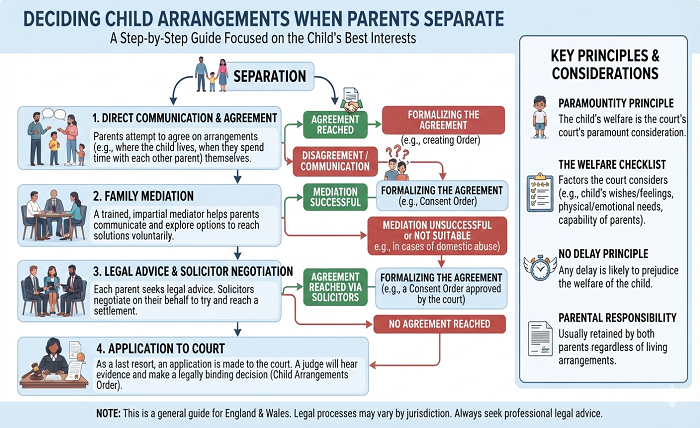
Child arrangements set out where a child lives and how much time they spend with each parent once a relationship ends. These cover the ordinary details of daily life, from which parent handles school pickups on a given day to where a child spends Christmas, and having them clearly settled avoids ongoing uncertainty for everyone involved. Parents are free to agree these details themselves, and most do, without a court ever getting involved.
How these arrangements actually get decided depends on whether parents can agree between themselves, need some help getting there, or end up asking a court to decide for them. Each route has a different process, timescale and level of formality, and knowing what each one involves makes it easier to choose the right starting point.
Resolving Arrangements Without Going to Court
Most parents work out child arrangements between themselves, often using a written parenting plan that covers school terms, holidays and regular contact, and this can be updated by agreement as circumstances change. Where parents cannot agree everything alone, mediation is usually the next step rather than a court application, and most people must attend a Mediation Information and Assessment Meeting before applying to court at all. Negotiating terms through mediation often involves expert solicitors working alongside each parent, reviewing proposals and making sure any agreement reached actually reflects what was discussed. This meeting is not required where there has been domestic abuse, since mediation is not considered appropriate for every situation.
When a Court Ends Up Deciding
If mediation does not resolve things or is not appropriate, either parent can apply to the family court for a Child Arrangements Order. The court’s central test is the welfare of the child, weighing their wishes, their needs and the effect any change would have on them, rather than favouring either parent by default. Cafcass, the agency that supports the family courts, is usually asked to carry out safeguarding checks before the first hearing, and cases can take several months to reach a final decision even when nothing is seriously disputed. A government scheme covering some mediation costs exists specifically to keep more cases out of court in the first place, since resolving matters this way is generally quicker for everyone involved.
Arrangements Are Rarely Fixed Forever
Whatever route a family uses, most arrangements need revisiting as children get older, change schools, or as a parent’s work or location changes. A parenting plan can be updated by agreement without any formal process, while a Child Arrangements Order can be varied by returning to court or, more commonly, by simply agreeing a change and following it in practice. Treating the first arrangement as a starting point rather than a permanent fixture tends to reduce conflict later on.
Getting good advice early tends to matter more than which route a case eventually takes. Commentary on the family courts has pointed to funding cuts affecting early legal advice as one reason some parents struggle to explore mediation properly before things escalate. Starting with whichever option genuinely fits a family’s circumstances, rather than assuming a court order is always necessary, usually produces arrangements that hold up better for the child over time.