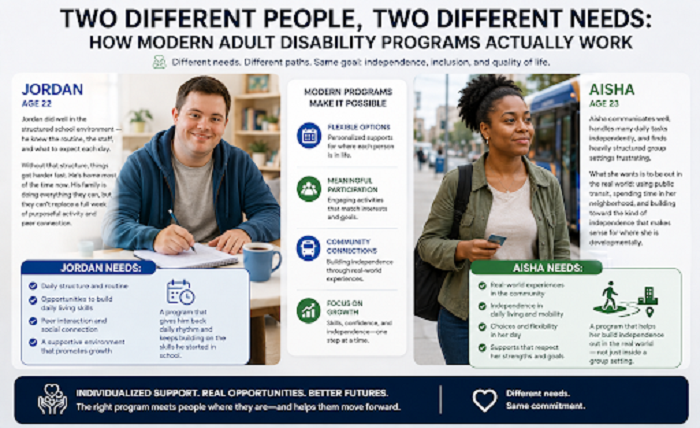
Jordan is 22. He aged out of school services six months ago. He did well in the structured school environment — he knew the routine, he knew the staff, he knew what was coming each day. Without that structure, things got harder fast. He’s home most of the time now, and while his family is doing everything they can, they’re not a substitute for a full week of purposeful activity and peer contact. He needs a program that gives him back that daily rhythm and keeps working on the daily living skills he started building in school.
Aisha is 23. She also just transitioned out of school, but her situation looks different. She communicates well, handles a lot of her daily tasks independently, and finds heavily structured group settings frustrating. What she wants is to be out in the real world: taking public transit on her own, spending time in her neighborhood, building toward the kind of independence that makes sense for where she actually is developmentally. A day spent in one room doing group activities isn’t what she needs right now.
Both of them need a day program for adults with developmental disabilities. They need completely different versions of one.
This is where a lot of families run into trouble. They’re looking for “a program” as if there’s one format that fits everyone who just aged out of school services. There isn’t. And putting a young adult in the wrong format — even a good program that’s just not the right fit — wastes months that matter a lot at this stage.
What the site-based format is actually good for
For someone like Jordan, a site-based Group Day Habilitation program provides something he genuinely needs: a predictable structure that shows up every day.
Same location. Same peers. A weekly schedule that has real shape to it. For young adults who thrived in the school environment because of its consistency, this kind of programming picks up where school left off. The transition is less of a cliff and more of a step.
Site-based programs are also where peer relationships form. This matters more than people usually give it credit for. Young adults with developmental disabilities lose their school-based social network when they age out, and nothing replaces it automatically. A program they attend five days a week with the same group of people is where new friendships actually happen. That’s not a soft outcome. It’s one of the things families notice most.
The limitation worth knowing: skills practiced only inside a building don’t always transfer well to the outside world. A good site-based program builds in regular community outings rather than running everything in-house. When visiting programs, it’s worth asking specifically how much time participants spend outside the facility each week and what those outings look like.
What community-based programming does differently
Group Day Habilitation Without Walls takes the program into the community. Participants go out into real environments — public transit, libraries, local businesses, parks — and work on skills where those skills will actually be used.
For Aisha, this is a much better fit. She isn’t practicing a transit route on a map. She’s riding the actual subway, handling whatever comes up when something goes wrong, building the kind of familiarity with her city that makes independence real rather than theoretical.
This format requires a baseline level of readiness. It works best for young adults who can function in variable, less controlled environments and are specifically working toward greater community independence. For someone who isn’t there yet, a primarily community-based format can be disorienting rather than building confidence.
It’s also worth noting that Without Walls programming tends to have less built-in peer continuity than site-based programs. Participants are out in different environments rather than spending extended time together in one place. For young adults who are socially isolated and need to build peer relationships, that’s a real tradeoff.
How programs can combine both
It doesn’t have to be one or the other. A lot of young adults benefit from a mix: site-based programming most of the week, with community outings built in, plus supplemental programming on evenings or weekends for social and recreational time. How that combination gets structured should depend on what the individual is working toward, not on what slots happen to be available.
The question to ask any provider: does the program structure start with the person’s goals, or does the person fit into a fixed structure? These produce different outcomes, and you can usually tell which one you’re dealing with pretty quickly.
How Gateway approaches this
Gateway Counseling Center runs both Group Day Habilitation and Group Day Habilitation Without Walls, along with Supplemental programming for evenings and weekends. For young adults just out of school, the intake process is built around understanding the individual’s goals and readiness before placing them in a program.
For Jordan, the site-based format at Gateway would rebuild the daily structure he lost when school ended, with consistent peers and staff working on the daily living skills his Life Plan identifies. For Aisha, the Without Walls format would put her skills to work in the community settings she actually wants to be in.
Both would get free transportation to and from programming and free meals throughout the day, which means families aren’t adding logistics to an already complicated transition period.
What families navigating this transition should know
The year or two after school ends is one of the more important windows in a young adult’s development. The habits, skills, and social connections that get built or don’t get built in this period tend to stick. A program that’s the wrong fit doesn’t just waste time. It can set back confidence and development that takes longer to recover than people expect.
Visit programs before enrolling. Ask how they handle the first few months with a new participant. Ask what happens when a young adult’s goals change and they’re ready for more independence. Ask about staff tenure.
Gateway offers free 30-minute tours at its New York City locations. The intake team can be reached at Intake@gccnyc.org or by phone at (718) 885-4986, and more information is available at www.gccnyc.org.