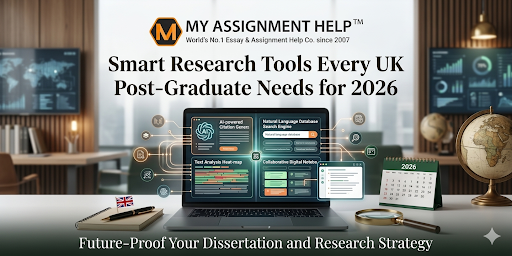
The landscape of higher education in the United Kingdom has undergone a seismic shift as we move further into 2026. With over 2.86 million students currently enrolled in UK higher education institutions, the competition for academic excellence and breakthrough research has never been more intense. Post-graduate life, whether you are pursuing a Master’s in Law at King’s College or a PhD in STEM at the University of Manchester, requires more than just grit; it requires a sophisticated digital toolkit.
As a post-graduate, your workflow is your lifeline. The sheer volume of data, from archival records to real-time analytics, can be overwhelming. Fortunately, the integration of specialized AI and data management software has streamlined the “Writing Engineering Lifecycle.” To navigate these complexities, many students seek professional Dissertation Help to ensure their structural integrity and academic tone meet the rigorous E-E-A-T (Experience, Expertise, Authoritativeness, and Trustworthiness) standards expected by UK examiners.
1. Advanced Discovery & Literature Review Tools
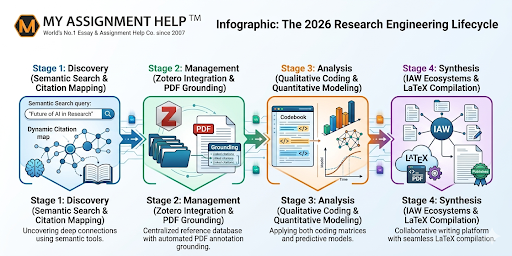
In 2026, the traditional search is dead. We are now in the era of semantic discovery. Tools like Google NotebookLM 2.0 have become staples for UK post-graduates handling massive PDF repositories. Unlike standard chatbots, it creates a “grounded” AI environment based strictly on your uploaded documents. It can generate audio summaries for your commute or auto-create flashcards for viva preparation.
Furthermore, services like Consensus and ResearchRabbit map the “citation galaxy.” ResearchRabbit allows you to visualize the connections between papers, helping you identify the seminal authors and the latest niche studies in your field without manual searching.
2. Qualitative & Quantitative Analysis Software
Data-driven research is the backbone of a successful thesis. UK universities have seen a significant increase in enrollment in research courses by 2025/26, reflecting a more diverse and data-literate researcher base. For qualitative researchers, NVivo and ATLAS.ti now feature “Transparent AI” assistance. They help in sub-coding and sentiment analysis while ensuring the researcher maintains full analytical judgment—a critical requirement for maintaining academic integrity.
If your research is quantitative, moving beyond basic Excel is vital. XLSTAT and JASP offer robust alternatives. JASP, in particular, provides a free, open-source interface for complex Bayesian statistics often required in social science and psychology post-grad modules. If the technical demands of data modeling become a bottleneck in your schedule, it is common to look for an expert to do my assignment for me to maintain your project’s momentum.
3. Integrated Writing Ecosystems
The days of juggling five different apps are over. The trend in 2026 is Integrated Academic Writing (IAW).
- Lattics: Awarded a top spot for academic writing software in 2026, Lattics integrates reference management, mind-mapping, and a “research canvas” into one interface.
- Zotero 7.0: The gold standard for reference management in the UK. Its new 2026 collaborative features allow PhD cohorts to annotate the same document in real-time, which is essential for joint publications.
Key Takeaways for 2026 Post-Graduates
| Category | Recommended Tool | Core Benefit |
| Discovery | NotebookLM 2.0 | Synthesizes 100+ PDFs into a single searchable knowledge base. |
| Analysis | NVivo | Accelerates pattern recognition in qualitative data with AI support. |
| Writing | Lattics | Combines outline construction and reference management in one “canvas.” |
| Integrity | Grammarly Academic | Specialized checks for UK English and academic tone consistency. |
FAQ: Navigating Research in 2026
Q: Is it considered plagiarism to use AI tools for literature reviews?
No, as long as you use them for discovery and synthesis. Using AI to write the actual text without attribution is plagiarism. Tools like NotebookLM are meant to help you understand your sources, not replace your writing.
Q: Which reference style is most common in the UK?
While it varies by department, Harvard (UK) and OSCOLA (for Law) remain the most prominent. Always ensure your software is set to the specific version required by your University’s style guide.
Author Bio: Angelika V.
Angelika is a Senior Academic Consultant at MyAssignmentHelp.com with an emphasis on UK Higher Education. With a background in content strategy and E-E-A-T compliance, she specializes in guiding post-graduate students through the complexities of dissertation structuring and advanced research methodologies.
References:
- HESA (2026). Higher Education Student Statistics: UK, 2024/25.
- UK Parliament (2026). Higher Education Student Numbers Research Briefing.
- Lumivero (2026). The Evolution of AI in Qualitative Research.